The Villain as Narrator: Why the Best Antagonists Stop Being "Evil" and Start Being Right

I've spent a lot of time lately thinking about the moment in Gone Girl when the floor falls out. It isn't the reveal that Amy is alive — we usually suspect that. It's the “Cool Girl” monologue.
When I first read it, I remember a distinct, uncomfortable prickle at the back of my neck. Not because Amy Dunne was “evil.” Because for about three pages, she was the most sensible person in the book. She was articulating a social performance so precisely that I found myself thinking: Well, she's not wrong.
That is the exact moment a villain becomes truly dangerous. Not when they pick up a knife. When they start making sense.
The Editor, Not Just the Villain
What makes Amy different from most fictional antagonists isn't that she believes she's the hero of her own story. We've been told that for years — every craft book from Story Grid to K.M. Weiland covers the idea that a villain's internal logic has to be coherent. That's table stakes now.
What's different about Amy is that she's not just the protagonist of a competing story. She's the editor of the only story that gets told.
She plants the diary. She stages the crime scene. She selects which version of events reaches the neighbours, the media, her parents, and eventually the reader. Her power isn't just that she believes she's right. It's that she controls which evidence survives. She understands that reality, in a marriage and in a media cycle, is largely a matter of who gets to narrate it first and most convincingly.
That's a different and more frightening kind of villain. The monster who threatens your body has limits. The narrator who shapes what everyone around you believes has none.
This is where I think a lot of villain-writing goes wrong. We focus on motivation, on backstory, on making sure the villain “has a reason.” Those things matter. But they're downstream of a more fundamental question: what is this character's relationship to truth? Are they someone who bends it, performs it, weaponises it, or genuinely can't tell the difference anymore between their version and the real one?
Amy does something more sophisticated than lie. She finds a true thing — the exhausting performance women are expected to sustain in relationships, the “Cool Girl” — and uses that legitimate observation as a foundation. Once you've agreed with her premise, she can lead you anywhere, including to a murder. The truth becomes a beachhead.
That's worth studying. A villain who is simply wrong is manageable. A villain who is right about something real, and uses that foothold to drag you toward a conclusion you never intended to reach, is genuinely unsettling. And unsettling is what we're after.
The Instinct to Parent Your Characters
Here's where I've struggled with my own work, and where I've watched other writers struggle too.
When you're deep in a draft, there's a protective instinct that kicks in around your antagonist. You want the reader to know who to root for. You want your protagonist to win cleanly. And so — often without realising it — you start softening the villain's logic. You make their plan slightly dumber than it should be. You give them a blind spot that's a little too convenient. You let them monologue past the point of plausibility.
I think of this as parenting your characters. You're making sure the right kid wins.
The problem is that readers feel it. When a villain's logic has been quietly trimmed to make the hero's path easier, the victory doesn't land the way it should. The hero hasn't actually defeated anything. They've just been handed the result. And the villain never had the chance to make you sweat.
The hardest part of writing a compelling antagonist is letting go of that parental control and asking, genuinely: if I were inside this character's specific wounds, with their specific intelligence and their specific version of events, why would this action feel not just justified but necessary? If the honest answer is “because I need the plot to move,” you've lost. If the answer is “because this is the only way I can finally be heard,” you have something real.
Amy Dunne didn't just happen to Nick. She was the logical conclusion of their relationship, and of the particular performance their marriage required of her. She was the mirror held up to his own performative nature, sharpened into a blade. That inevitability is what makes the ending feel earned rather than arbitrary. Looking back from the last page, you can trace every step. There was no other place it could have gone.
That's the test I try to apply: can I trace my villain's final action all the way back to who they were on page one? If the ending surprises me when I look backward, I've probably been parenting somewhere along the way.
A Diagnostic You Can Use Today
If you're working on a manuscript right now and your antagonist feels thin, try this before you do anything else.
Write one page from your villain's point of view, in the first person, the morning before the story's central conflict escalates. Don't write them as a villain. Write them as someone who has been pushed to the edge of what they can tolerate and has finally decided to do something about it. Let them be unreliable. Let them be partly right. Let them use real observations as cover for the thing they're actually protecting.
If you come out of that page not understanding them better, the problem is probably that you haven't yet located the specific truth they're standing on. Find that truth first. Everything else follows.
Lisa Cron, in Wired for Story, frames this as the character's core misbelief — the thing a character has come to believe about the world as a result of their wound, which organises all of their subsequent choices. It's a useful frame for protagonists. For villains, I think it's even more useful, because the misbelief is usually more elaborately defended and more thoroughly weaponised. The more airtight the villain's internal justification, the more the reader feels the weight of what the hero has to dismantle.
What This Asks of the Writer
I don't think we need more advice on how to write compelling villains. I think we need more honesty about what gets in the way of writing them.
The real obstacle isn't craft. It's self-awareness. We all have that inner narrator who reinterprets our own failures, reassigns blame, and builds a version of the story where we are the ones who were genuinely wronged. It's a very human mechanism. A great villain is what happens when that mechanism runs unchecked, when it's given a face and a specific intelligence and the determination to act on its conclusions.
The writers I've seen do this best are the ones willing to follow that voice without flinching, to give it room to make its case before they decide what to do with it. Not because they endorse the conclusions, but because they know that's where the real charge lives.
When you stop trying to make your antagonist “evil” and start trying to make them coherent, something shifts. The reader starts to feel that same prickle at the back of their neck. That uncomfortable moment of well, they're not entirely wrong.
That discomfort is the point. That's when the story is doing its job.
Story Stream's antagonist analysis is built around exactly this question: what is the coherent internal logic driving your villain's choices, scene by scene? If you're wrestling with a flat antagonist in your current draft, it's worth running them through the tool.
More from the Blog
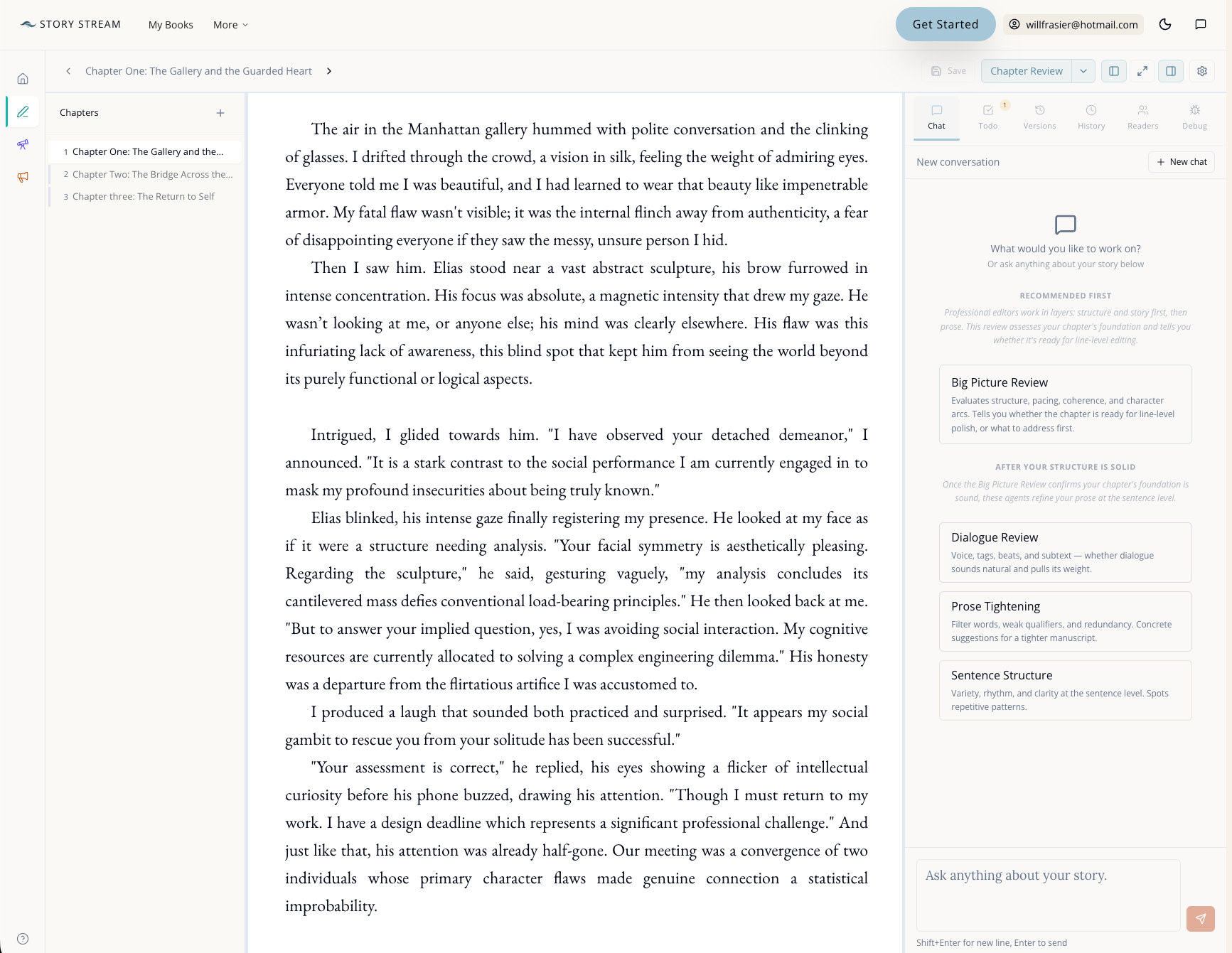
Introducing Manuscript: An Editor Beside You As You Write
Story Stream Manuscript brings our deep narrative model into the writing surface. Get chapter reviews, craft reviews, beta readers, writing coaching, voice read-aloud, and a revision checklist while you write, with editorial feedback grounded in the story you've actually written.
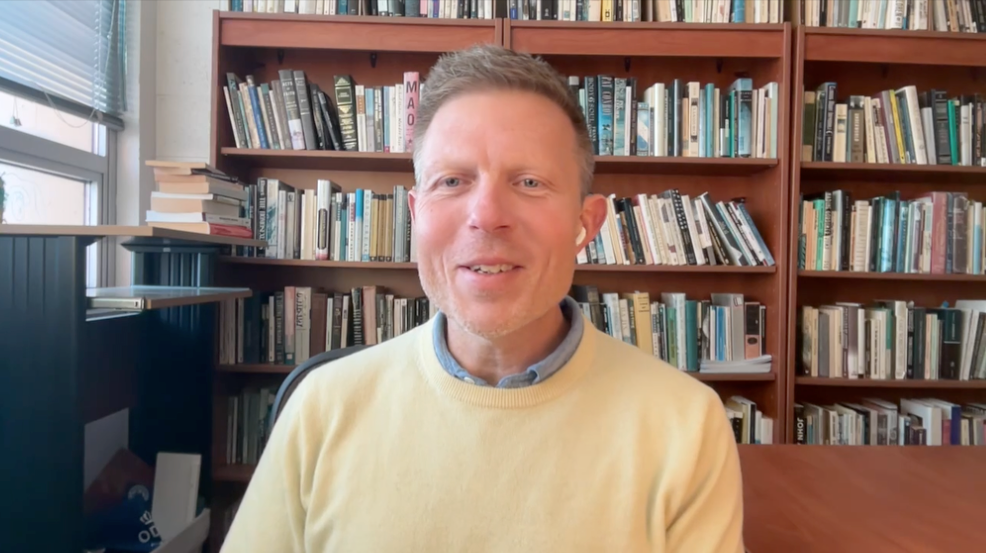
Interview with John McManus: AI, Storytelling, and the Future of Creative Writing
Acclaimed Southern Gothic writer and Whiting Award winner John McManus shares his optimistic vision for the future of storytelling. From democratizing creative tools to the emergence of new narrative forms, discover why artists have nothing to fear from AI.
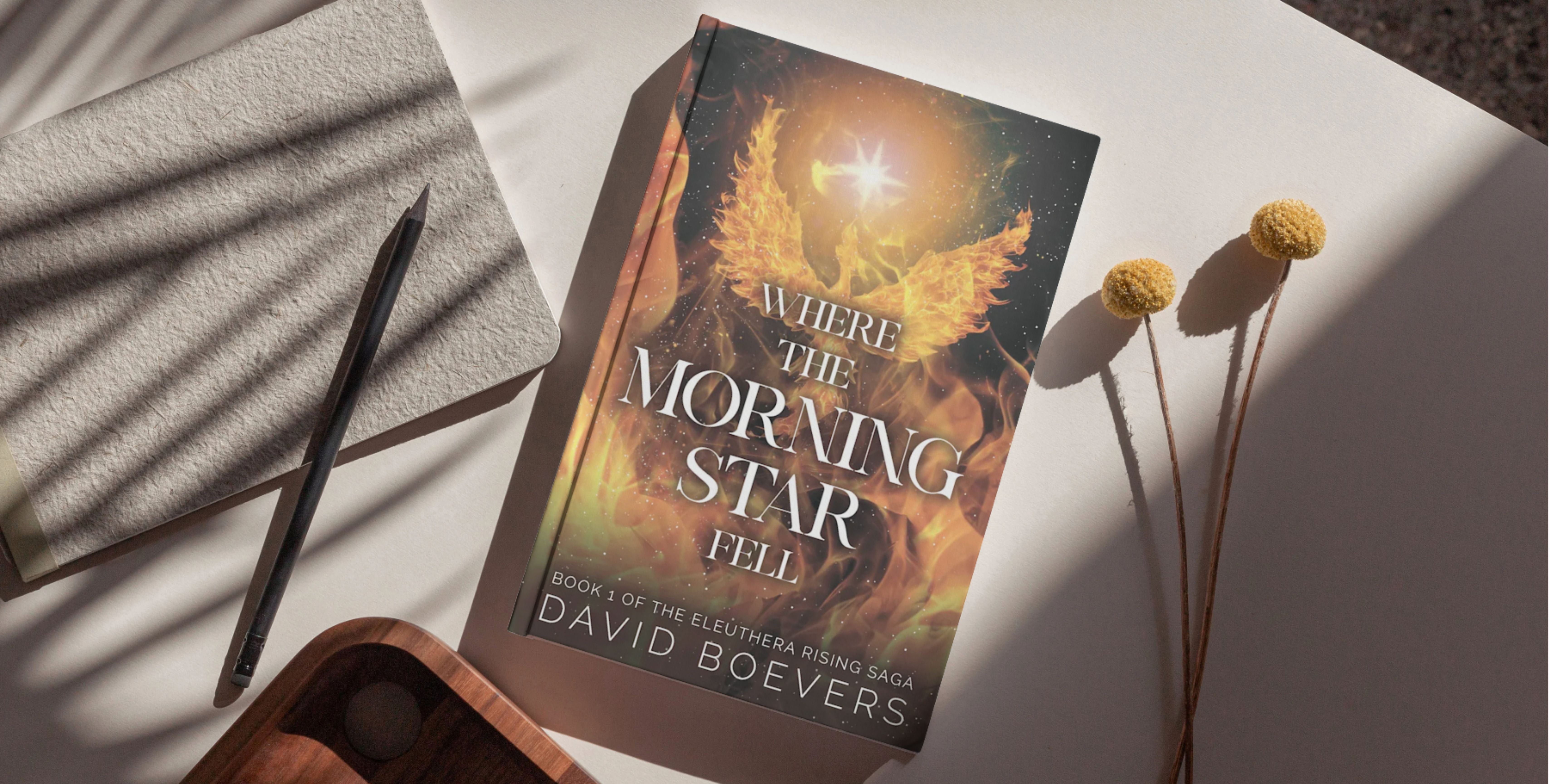
Interview with David Boevers, Author of Where the Morning Star Fell
Sci-fi author and educator David Boevers shares how Story Stream helps him revise with precision, purpose, and limited writing time. Discover his process, his Eleuthera universe, and how the Chapter Analyzer keeps his revisions on track.

7 Myths About First Drafts That Are Holding You Back
Let go of perfectionism and embrace the messy truth of first drafts. Discover the 7 common myths that keep writers stuck—and the truths that set you free to create boldly, imperfectly, and authentically.

Meet Jessica James: A Story Stream Success Story
Award-winning author Jessica James shares how Story Stream helped her deepen a dual-era historical mystery, uncover fresh ideas, and return to her creative rhythm.

Tension to Twist: Writing Thrillers That Stay With Readers
Build suspense that lingers after the last page with tension, atmosphere, and grounded stakes your readers can feel.